
Why? It’s a question I’m often asked by clients. Why have I got: cancer? Or arthritis? Or ME? Or whatever other condition they’ve come to me for. You name the illness, people are usually looking for a reason as to why it’s developed in them.
Of course, if they’ve smoked 40 a day for the past 50 years and developed lung cancer, then the reason seems fairly straight forward. Although, surprisingly, even carcinogenic substances like tobacco have differing effects on different people. I knew a man who started smoking at the age of 12 and regularly puffed through at least 2 packs a day until he died in his late 80s. (I’m not recommending this by the way.) Alternatively, a friend of my father, who had never smoked a cigarette in his life, died of lung cancer in his 30s. There is no,`one size fits all’ on illness. Every single human body is different and will react differently.

Many years ago I worked as a volunteer at The Samaritans, a `listening service’ for people who had reached the end of their tether and wanted to end their lives. The training was rigorous and one of the abiding memories for me was that we were taught never to ask why? Asking why has a subtext of making someone wrong: they shouldn’t be doing it. And, when someone has a noose around their neck or a bottle of pills in front of them, making them feel guilty isn’t going to support anyone. So, like `should/n’t‘, why is a word I try to avoid if at all possible.
So, what I say to clients is: does it matter why you’ve got whatever it is you’ve got? Because trying to find a reason for illness is often a way of blaming ourselves or others for what has happened. It was the fault of the cigarette company for getting me addicted! Was it? Did they really hold a cigarette to your lips and force you to inhale? But, in the US people have actually sued tobacco companies for compensation and won! It’s the fault of all the X-rays the doctors/dentist/my parents made me have as a child. Well, perhaps – in my childhood, every shoe-shop had an X-ray machine and our feet were X-rayed each time we got new shoes – but not everyone of my age has contracted cancer (yet!) It’s the pesticides in our food; the chemicals in the drinking water; the pollution from car engines…. the list of toxins in modern living is endless.
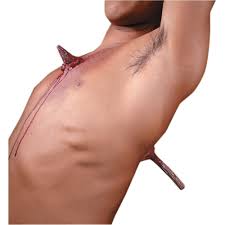
I heard a story by a Zen master recently. It went something along the lines of: if you’re shot by an arrow, you don’t waste time asking who shot you and why they did it; you get on with the business of removing the arrow. And that really resonated with me. We are all human. Our bodies are frail and susceptible to illness – at any age. Instead of using energy to try to find out why it’s happened, how much more productive to get on with the business of unblocking our energy channels and allowing healing energy to flow into us so that we can, hopefully, recover again.
So, a more pertinent question is perhaps not why? But how? How can I get well? There are the NHS guidelines of course:
- eating more fruit and veg
- cutting down on red meat
- getting more exercise
- avoiding smoke and fumes
- reducing stress
And there’s an additional recipe for healing that some people find harder to embrace: acceptance!
Accepting one’s illness doesn’t mean surrendering to it and giving in: it means being pro-active rather than re-active. Accepting that this has happened and exploring your options: a change of diet, resting more to conserve your energy, seeking complementary treatments, avoiding certain substances – and people – who are harmful to you and your condition – rather than railing against your illness and trying to blame yourself or others. And, even if we’re not ill at the moment, we can always ask, how can I improve or maintain my current good health?
So, as I am struggling to accept a particularly persistent chest infection myself at the moment, I shall just go and take a spoonful of my own medicine and self-administer some Reiki. After all, there’s no point in having it if I don’t use it.
Here’s to your, and my, good health!









 Reiki in Wanstead